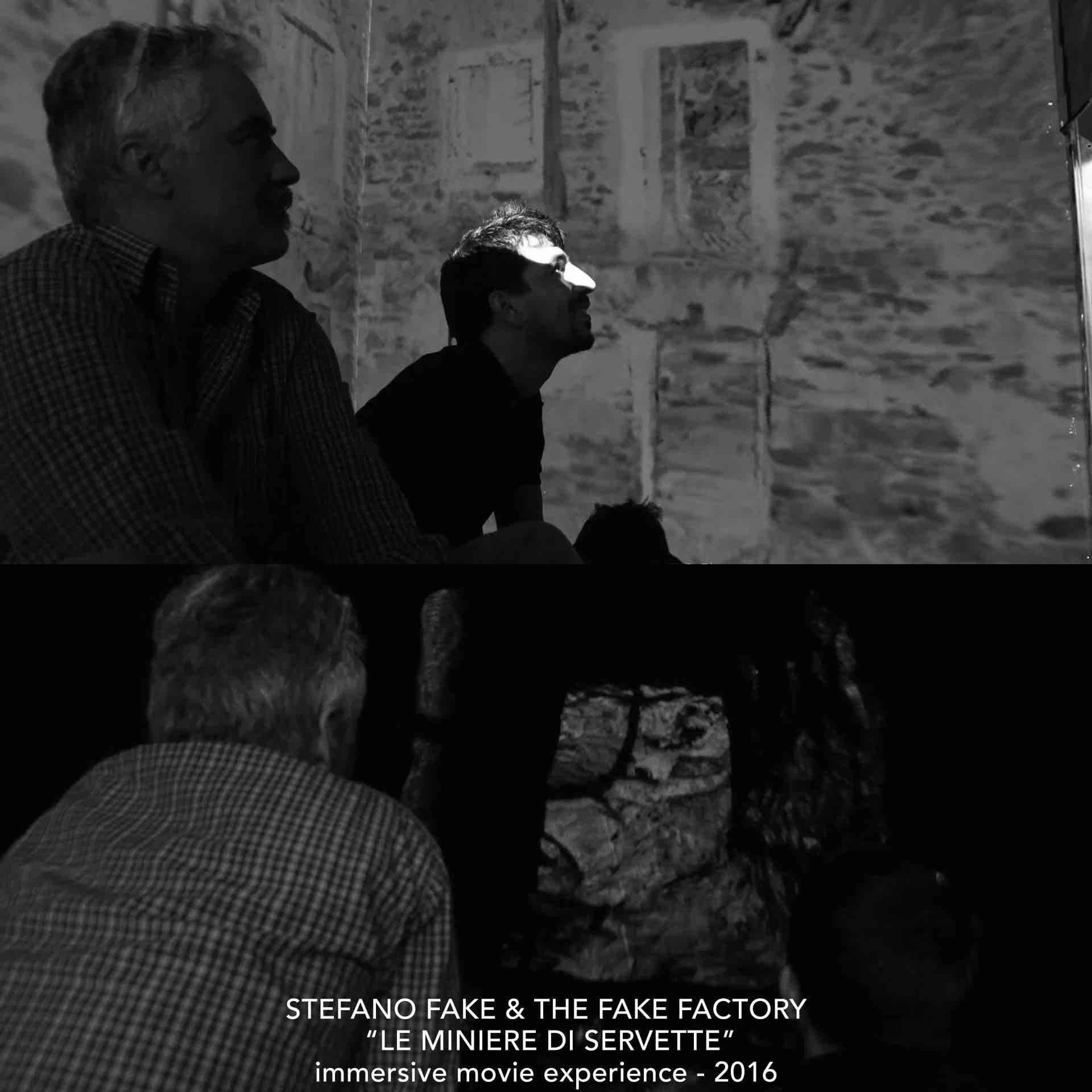
STEFANO FAKE & THE FAKE FACTORY – LE MINIERE DI SERVETTE point clouds immersive movie experience – 2016
Floating point cloud data >> Immersive room experience
LE MINIERE DI SERVETTE installazione video immersiva
SAINT-MARCEL (AOSTA)
un progetto HYDEA – Firenze (www.hydea.it)
Produzione Esecutiva: Andrea Deserventi
Regia: Stefano Fake & The Fake Factory
Installazione video immersiva: THE FAKE FACTORY
COMUNE DI SAINT-MARCEL (AOSTA) CENTRO DOCUMENTALE VIVIMINIERA
Presso il comune di Saint-Marcel è stato creato uno spazio espositivo scenografico che accoglie il visitatore in spazi divulgativi, didattici e suggestivi.
Il centro VIVIMINIERA è gestito direttamente da un gruppo di volontari.
Ambienti in penombra si succedono a spazi illuminati che portano il visitatore ai vari punti informativi; le soluzioni illuminotecniche che si sono adottate consentono un alto livello di concentrazione sulle informazioni esposte con una maggiore facilità di apprendimento.
Per informazioni di orari e costi
minieresaintmarcel.it
mine-experience.com
L’Archeologia dello Sguardo Numerico: Le Miniere di Servette e l’Estetica delle Point Clouds in Stefano Fake & The Fake Factory
Verso una Cartografia dell’Immateriale
Nel panorama della new media art contemporanea, la ricerca condotta da Stefano Fake & The Fake Factory si distingue per la capacità di interrogare la materia attraverso la lente della computazione algoritmica e della luce. Con l’installazione videoimmersiva Le Miniere di Servette (2016), sviluppata attraverso la formula della point clouds immersive movie experience, il collettivo compie un salto paradigmatico: il passaggio dalla rappresentazione mimetica dello spazio storico-industriale alla sua trasmutazione in puro campo dati luminoso. L’opera non si limita a documentare un sito minerario dismesso, ma ne istituisce una ri-fondazione ontologica, sostituendo la consistenza geologica della pietra con la geometria pulviscolare delle nuvole di punti (point clouds).
In questa prospettiva, l’installazione si inserisce in un dibattito accademico avanzato sul post-mediale, ridefinendo lo statuto del monumento e del paesaggio nell’era della digitalizzazione integrale del reale.
La Nuvola di Punti come Ontologia del Visibile (Floating Point Cloud Data)
Il fulcro tecnico-concettuale de Le Miniere di Servette risiede nell’acquisizione tridimensionale dello spazio mediante scansione laser e nella successiva restituzione visiva sotto forma di floating point cloud data. Tradizionalmente concepite come strumenti di rilevamento metrico e topografico per l’ingegneria e il restauro conservativo, le nuvole di punti vengono qui elevate da Stefano Fake a medium estetico autonomo.
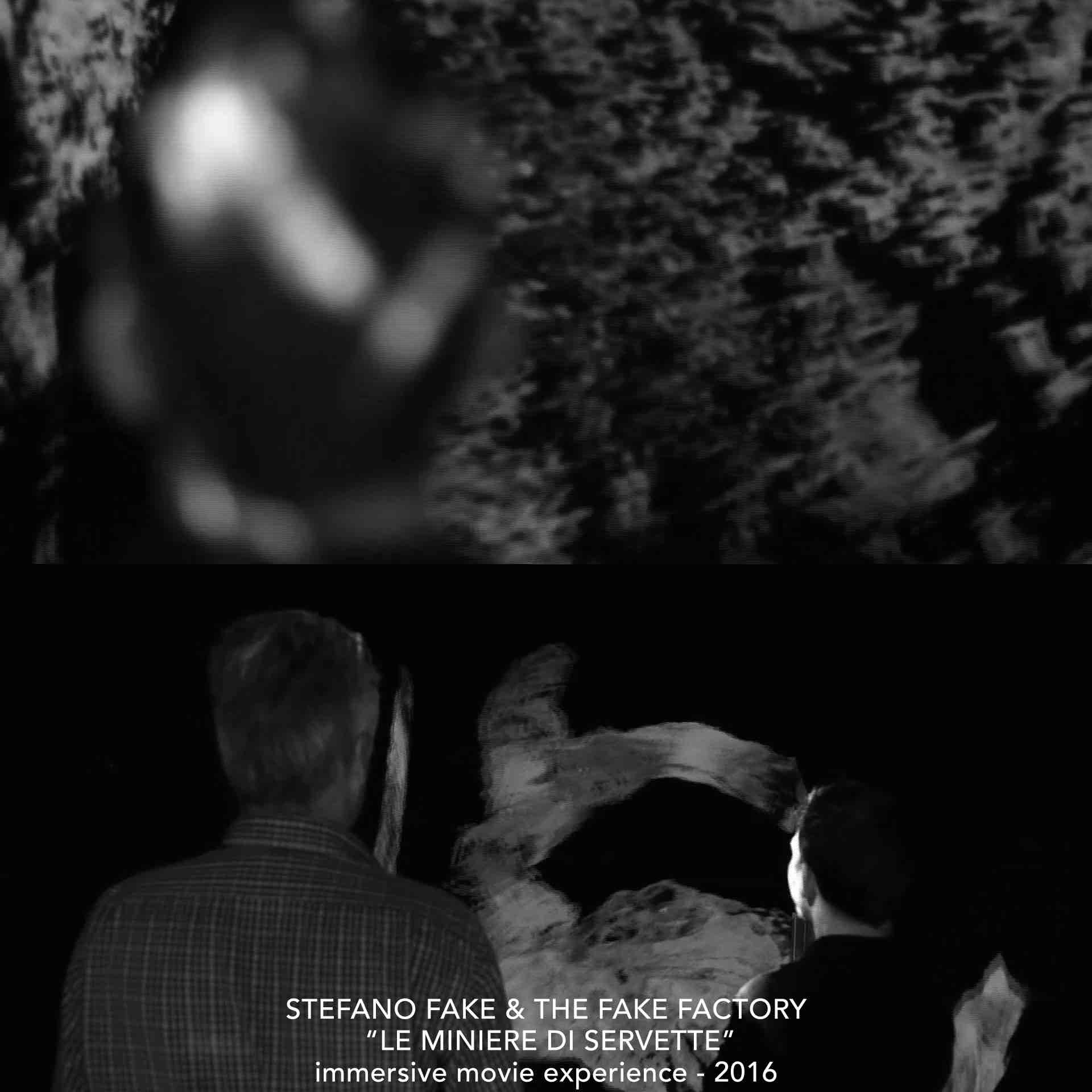
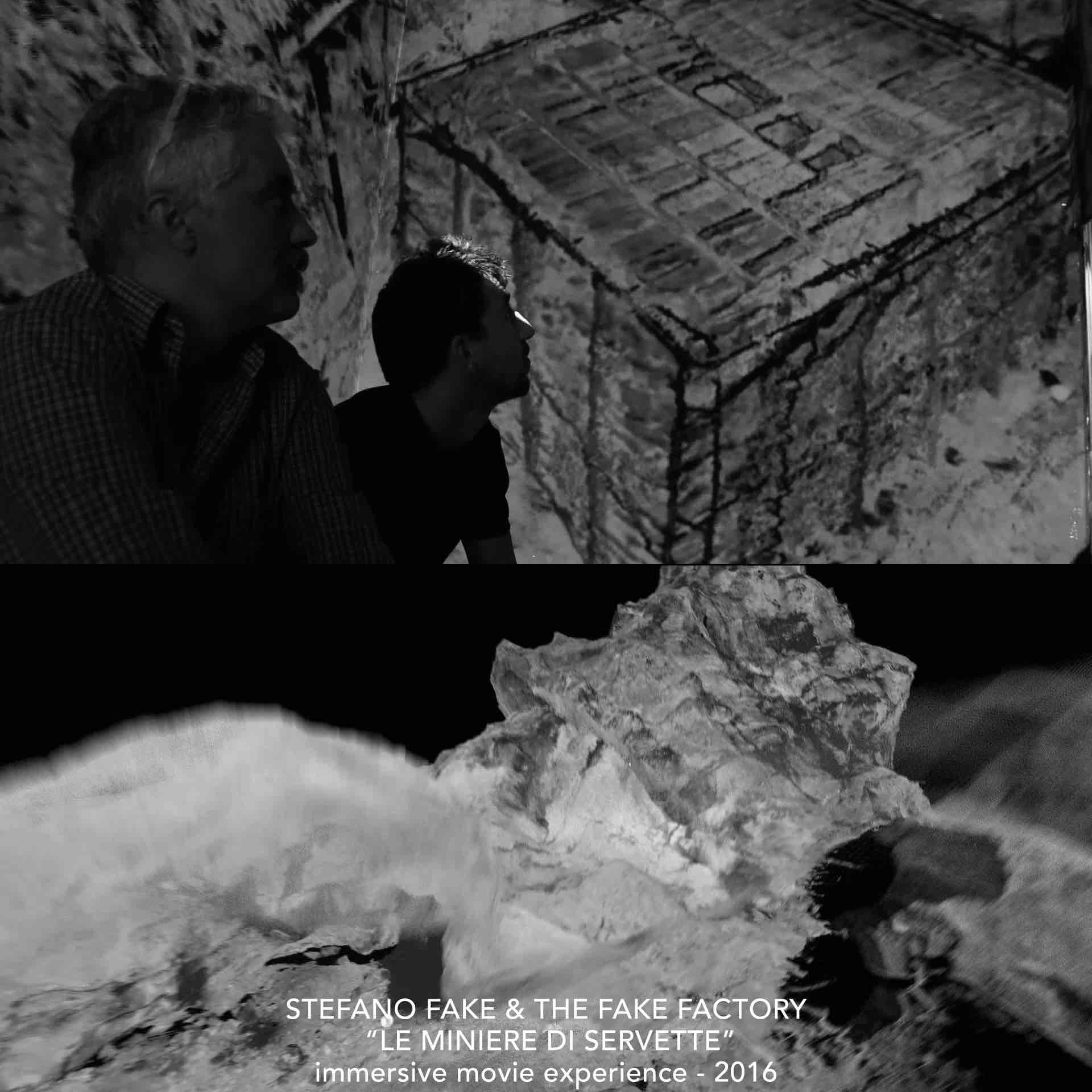
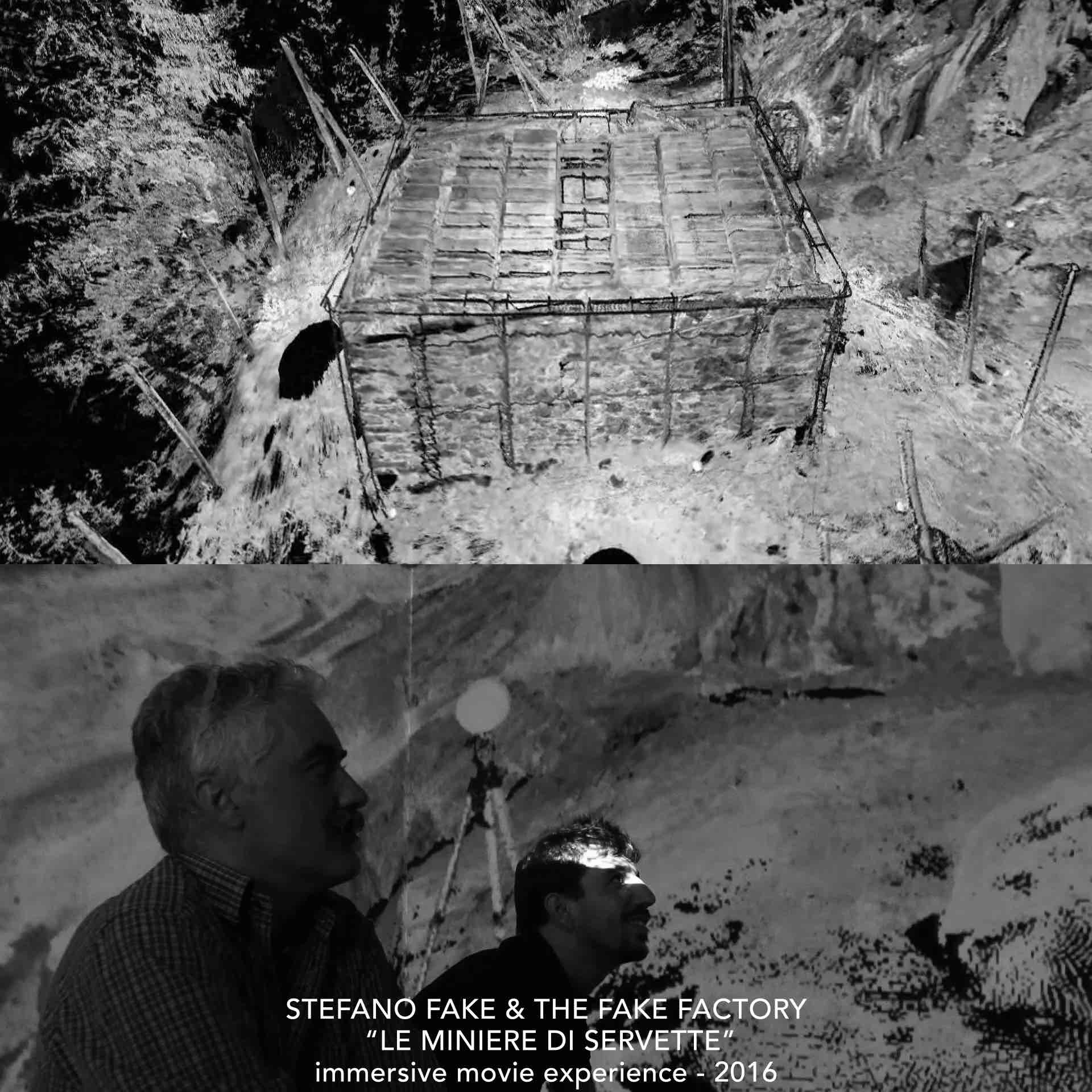
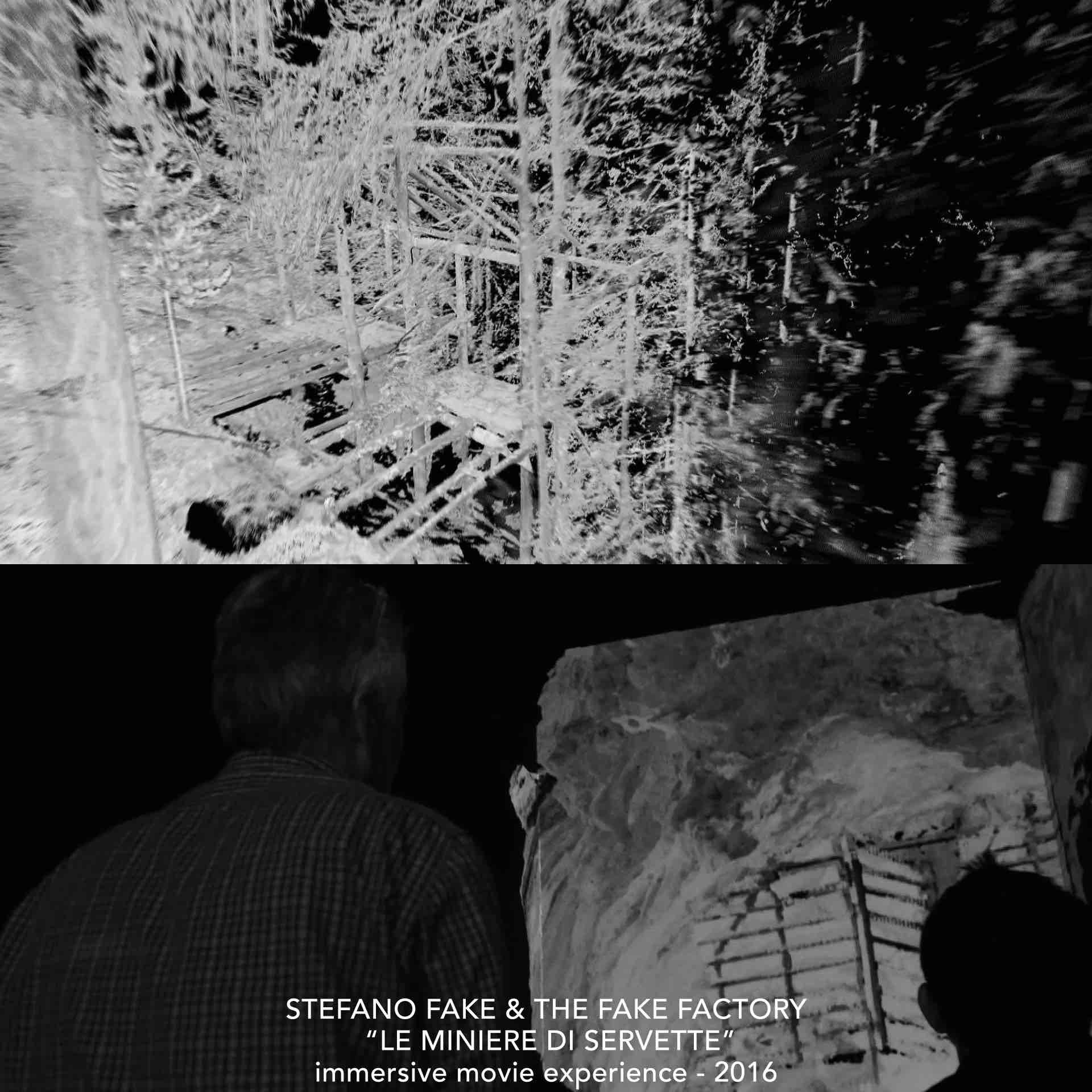
Nel regime estetico della point cloud, la volumetria solida della miniera si dissolve: le gallerie, i minerali, i crepacci e le strutture di sostegno perdono la loro impenetrabilità fisica per scomporsi in costellazioni di coordinate cartesiane x, y, z dotate di valori cromatici e luminosi. Come in una moderna pittura divisionista o in un cielo stellato digitale, lo spazio non è più definito da linee di contorno o superfici continue, ma da un volume d’aria denso di informazione numerica. Lo spettatore che accede all’immersive room sperimenta una vertigine fenomenologica: cammina all’interno di una memoria geologica che ha dismesso la sua gravità materiale per farsi pura frequenza fotonica.
Dalla Geologia alla Luce: L’Esperienza Immersiva e il Tempo Sospeso
Nelle sale immersive di The Fake Factory, la proiezione video a 360 gradi non assolve a una funzione decorativa o illustrativa, bensì trasforma l’ambiente architettonico in una cassa di risonanza sensoriale e cognitiva. Le Miniere di Servette opera una scomposizione temporale: il tempo stratificato della miniera — accumulato in secoli di escavazione mineraria e successivamente consegnato all’abbandono e al silenzio — viene riattivato attraverso il flusso dinamico delle immagini di sintesi.
Il movimento della telecamera virtuale che naviga all’interno della nuvola di punti restituisce una sensazione di sublime tecnologico. Le pareti rocciose, scannerizzate e riconfigurate in tempo reale, fluttuano intorno al fruitore in un continuum visivo ipnotico. La miniera non è più un luogo geografico circoscritto (la celebre area mineraria valdostana), ma diventa un archetipo universale dello spazio sotterraneo, un ventre materico in cui l’industria umana si riconcilia con la smaterializzazione digitale.
Archeologia Industriale e Post-Digitalità
L’operazione condotta da Stefano Fake ne Le Miniere di Servette interseca i territori dell’archeologia industriale e del post-digital. Nell’epoca dell’Antropocene, in cui i siti di estrazione delle risorse naturali rappresentano le cicatrici più evidenti lasciate dal modello estrattivista moderno, l’utilizzo di una tecnologia avanzata come il rilievo a nuvola di punti per “salvare” e trasfigurare la miniera assume una valenza politica e poetica profonda.
La materia prima estratta non è più il minerale ferroso o rameifero, ma il dato spaziale. La digitalizzazione del sito minerario trasforma il giacimento fisico in un giacimento informatico, un archivio immateriale che sopravvive alla decadenza della materia organica e minerale. Attraverso questa alchimia digitale, The Fake Factory dimostra come l’arte immersiva possa farsi carico della memoria storica, non congelandola in teche museali, ma restituendola in forma di ecosistema vivente, in cui lo spettatore si muove letteralmente “dentro” l’archivio dei dati (Inside Art).
L’Architettura della Percezione
Con Le Miniere di Servette (2016), Stefano Fake & The Fake Factory consolidano una poetica in cui la tecnologia di frontiera — il point cloud scanning e il video mapping immersivo — non serve a simulare illusionisticamente la realtà, bensì a espandere i confini della percezione umana. L’opera si configura come un classico della new media art, capace di dimostrare che la nuvola di punti non è una fredda rappresentazione matematica, ma una nuova forma di lirismo visivo: un monumento immateriale eretto alla memoria della terra e alla transitorialità dell’essere umano nel terzo millennio.
The Archaeology of the Numerical Gaze: The Servette Mines and the Aesthetics of Point Clouds in Stefano Fake & The Fake Factory
Towards a Cartography of the Immaterial
In the landscape of contemporary new media art, the research conducted by Stefano Fake & The Fake Factory stands out for its ability to interrogate matter through the lens of algorithmic computation and light. With the immersive video installation The Servette Mines (2016), developed through the formula of the point cloud immersive movie experience, the collective makes a paradigmatic leap: the transition from the mimetic representation of historical-industrial space to its transmutation into a pure luminous data field. The work does not merely document a decommissioned mining site, but establishes an ontological refoundation of it, replacing the geological consistency of stone with the corpuscular geometry of point clouds.
From this perspective, the installation engages with an advanced academic debate on the post-media condition, redefining the status of the monument and the landscape in the era of the integral digitalization of the real.
The Point Cloud as an Ontology of the Visible (Floating Point Cloud Data)
The technical-conceptual core of The Servette Mines lies in the three-dimensional acquisition of space via laser scanning and its subsequent visual rendering in the form of floating point cloud data. Traditionally conceived as tools for metric and topographic surveying in engineering and conservative restoration, point clouds are here elevated by Stefano Fake to an autonomous aesthetic medium.
Within the aesthetic regime of the point cloud, the solid volumetry of the mine dissolves: the tunnels, minerals, crevasses, and support structures lose their physical impenetrability to decompose into constellations of Cartesian x, y, z coordinates endowed with chromatic and luminous values. Much like a modern Divisionist painting or a digital starry sky, space is no longer defined by contour lines or continuous surfaces, but by a volume of air dense with numerical information. The spectator who enters the immersive room experiences a phenomenological vertigo: they walk inside a geological memory that has shed its material gravity to become pure photonic frequency.
From Geology to Light: The Immersive Experience and Suspended Time
In the immersive rooms of The Fake Factory, the 360-degree video projection does not serve a decorative or illustrative function, but rather transforms the architectural environment into a sensory and cognitive resonance chamber. The Servette Mines enacts a temporal decomposition: the stratified time of the mine—accumulated over centuries of mining excavation and subsequently consigned to abandonment and silence—is reactivated through the dynamic flow of synthetic images.
The movement of the virtual camera navigating within the point cloud evokes a sense of the technological sublime. The rock walls, scanned and reconfigured in real-time, float around the viewer in a hypnotic visual continuum. The mine is no longer a circumscribed geographical location (the famous mining area in the Aosta Valley), but becomes a universal archetype of underground space, a material womb in which human industry reconciles with digital dematerialization.
Industrial Archaeology and Post-Digitality
The operation conducted by Stefano Fake in The Servette Mines intersects the territories of industrial archaeology and the post-digital. In the age of the Anthropocene, where natural resource extraction sites represent the most evident scars left by the modern extractivist model, the use of advanced technology such as point cloud surveying to “save” and transfigure the mine assumes a profound political and poetic significance.
The raw material extracted is no longer iron or copper ore, but spatial data. The digitalization of the mining site transforms the physical deposit into a computerized deposit, an immaterial archive that survives the decay of organic and mineral matter. Through this digital alchemy, The Fake Factory demonstrates how immersive art can take charge of historical memory, not by freezing it in museum display cases, but by rendering it in the form of a living ecosystem, in which the spectator moves literally “inside” the data archive (Inside Art).
The Architecture of Perception
With The Servette Mines (2016), Stefano Fake & The Fake Factory consolidate a poetics in which frontier technology—point cloud scanning and immersive video mapping—does not serve to illusionistically simulate reality, but rather to expand the boundaries of human perception. The work stands as a classic of new media art, capable of demonstrating that the point cloud is not a cold mathematical representation, but a new form of visual lyricism: an immaterial monument erected to the memory of the earth and the transitoriness of the human being in the third millennium.
—
Avete mai provato la sensazione di volare dentro ad una realtà tridimensionale ricreata attraverso le più sofisticate tecnologie digitali, i laser scan che ricreano lo spazio tridimensionale attraverso una nuvola di punti?
Da quando arte e tecnologia si sono riunite grazie alla rivoluzione digitale, una nuova forma di espressione artistica si è imposta all’attenzione del pubblico conquistando milioni di visitatori in tutto il mondo, dalla Francia all’Italia, dagli Stati Uniti alla Cina.
Gli ingredienti di questo successo sono probabilmente le grandi video proiezioni accompagnate da emozionanti colonne sonore, ma questo non basta a spiegare il fenomeno. Come scrive Stefano Fake, uno dei maggiori autori internazionali di esperienze digitali immersive ed autore di questa immersione nel sottosuolo delle Miniere di Servette “non si tratta semplicemente di realizzare dei filmati che circondano lo spettatore, ma di creare un percorso che stimola la mente e i sensi del visitatore e lo trasporta in una nuova esperienza sensoriale ed estetica mai provata prima. L’oggetto della nostra ricerca come artisti digitali è proprio l’insieme delle sensazioni che il pubblico vive all’interno dell’esperienza multimediale”.
Ecco perché gli autori amano definirle “esperienze” piuttosto che “mostre”, termine con il quale ci riferiamo alle esposizioni tradizionali. Continua Fake : “la grande rivoluzione digitale che caratterizza la nostra epoca sta cambiando non solo il modo in cui viviamo quotidianamente, ma anche il modo in cui sperimentiamo le esperienze estetiche e l’arte in particolare.”
Le installazioni di questi artisti multimediali operano una ri-locazione dei cunicoli delle miniere originarie di Saint Marcel in uno spazio espositivo presente che permette di vedere quelle stesse miniere sotto una nuova luce, contemporanea, creando nuovi percorsi interpretativi ed esperenziali. Stimolando la voglia di salire in quota per visitare le miniere riaperte al pubblico, accompagnati dalle esperte guide locali in tour guidati diurni e notturni.
stefanofake.art
immersiveexperience.art
immersivemirrorroom.art









The Archaeology of the Numerical Gaze: The Servette Mines and the Aesthetics of Point Clouds in Stefano Fake & The Fake Factory
Towards a Cartography of the Immaterial
In the landscape of contemporary new media art, the research conducted by Stefano Fake & The Fake Factory stands out for its ability to interrogate matter through the lens of algorithmic computation and light. With the immersive video installation The Servette Mines (2016), developed through the formula of the point cloud immersive movie experience, the collective makes a paradigmatic leap: the transition from the mimetic representation of historical-industrial space to its transmutation into a pure luminous data field. The work does not merely document a decommissioned mining site, but establishes an ontological refoundation of it, replacing the geological consistency of stone with the corpuscular geometry of point clouds.
From this perspective, the installation engages with an advanced academic debate on the post-media condition, redefining the status of the monument and the landscape in the era of the integral digitalization of the real.
The Point Cloud as an Ontology of the Visible (Floating Point Cloud Data)
The technical-conceptual core of The Servette Mines lies in the three-dimensional acquisition of space via laser scanning and its subsequent visual rendering in the form of floating point cloud data. Traditionally conceived as tools for metric and topographic surveying in engineering and conservative restoration, point clouds are here elevated by Stefano Fake to an autonomous aesthetic medium.
Within the aesthetic regime of the point cloud, the solid volumetry of the mine dissolves: the tunnels, minerals, crevasses, and support structures lose their physical impenetrability to decompose into constellations of Cartesian x, y, z coordinates endowed with chromatic and luminous values. Much like a modern Divisionist painting or a digital starry sky, space is no longer defined by contour lines or continuous surfaces, but by a volume of air dense with numerical information. The spectator who enters the immersive room experiences a phenomenological vertigo: they walk inside a geological memory that has shed its material gravity to become pure photonic frequency.
From Geology to Light: The Immersive Experience and Suspended Time
In the immersive rooms of The Fake Factory, the 360-degree video projection does not serve a decorative or illustrative function, but rather transforms the architectural environment into a sensory and cognitive resonance chamber. The Servette Mines enacts a temporal decomposition: the stratified time of the mine—accumulated over centuries of mining excavation and subsequently consigned to abandonment and silence—is reactivated through the dynamic flow of synthetic images.
The movement of the virtual camera navigating within the point cloud evokes a sense of the technological sublime. The rock walls, scanned and reconfigured in real-time, float around the viewer in a hypnotic visual continuum. The mine is no longer a circumscribed geographical location (the famous mining area in the Aosta Valley), but becomes a universal archetype of underground space, a material womb in which human industry reconciles with digital dematerialization.
Industrial Archaeology and Post-Digitality
The operation conducted by Stefano Fake in The Servette Mines intersects the territories of industrial archaeology and the post-digital. In the age of the Anthropocene, where natural resource extraction sites represent the most evident scars left by the modern extractivist model, the use of advanced technology such as point cloud surveying to “save” and transfigure the mine assumes a profound political and poetic significance.
The raw material extracted is no longer iron or copper ore, but spatial data. The digitalization of the mining site transforms the physical deposit into a computerized deposit, an immaterial archive that survives the decay of organic and mineral matter. Through this digital alchemy, The Fake Factory demonstrates how immersive art can take charge of historical memory, not by freezing it in museum display cases, but by rendering it in the form of a living ecosystem, in which the spectator moves literally “inside” the data archive (Inside Art).
The Architecture of Perception
With The Servette Mines (2016), Stefano Fake & The Fake Factory consolidate a poetics in which frontier technology—point cloud scanning and immersive video mapping—does not serve to illusionistically simulate reality, but rather to expand the boundaries of human perception. The work stands as a classic of new media art, capable of demonstrating that the point cloud is not a cold mathematical representation, but a new form of visual lyricism: an immaterial monument erected to the memory of the earth and the transitoriness of the human being in the third millennium.
Have you ever experienced the sensation of flying inside a three-dimensional reality recreated through the most sophisticated digital technologies, laser scans that recreate three-dimensional space through a point cloud?
Ever since art and technology reunited thanks to the digital revolution, a new form of artistic expression has commanded public attention, captivating millions of visitors worldwide, from France to Italy, from the United States to China.
The ingredients for this success are likely large-scale video projections accompanied by stirring soundtracks, but this alone does not explain the phenomenon. As Stefano Fake, one of the leading international creators of immersive digital experiences and the author of this immersion into the underground of the Servette Mines, writes: “It is not simply a matter of making videos that surround the viewer, but of creating a journey that stimulates the visitor’s mind and senses, transporting them into a new sensory and aesthetic experience never felt before. The object of our research as digital artists is precisely the set of sensations that the public experiences within the multimedia encounter.”
This is why the creators prefer to call them “experiences” rather than “exhibitions,” a term we reserve for traditional displays. Fake continues: “The great digital revolution characterizing our era is changing not only the way we live our daily lives, but also the way we experience aesthetic encounters and art in particular.”
The installations by these multimedia artists relocate the tunnels of the original mines of Saint Marcel into a present-day exhibition space, allowing those same mines to be viewed in a new, contemporary light, creating fresh interpretive and experiential pathways. This stimulates the desire to ascend to the heights to visit the mines reopened to the public, accompanied by expert local guides on daytime and nighttime guided tours.

